By: Sophia Hamilton (2014 GDB Puppy Raising Scholarship Recipient for Overall Achievement)
“How will you give her up?” Everywhere I went this question was posed about Almond, the little guide dog puppy that stood by my side. Truthfully I had asked myself this same question countless times, and in the beginning I had no idea what the answer was.
Almond was the first of three puppies I raised for Guide Dogs for the Blind. I began raising puppies in 2009, when my 8th grade teacher assigned the project I was to complete over the course of my final year in grade school. I decided that training a guide dog puppy would be perfect. Becoming part of this organization has been one of the most enjoyable and rewarding things I have done thus far in my life.
Throughout my four years of high school, I had puppies on campus with me from time to time. People would ask me all the time about the program and what my specific duties with these dogs were. Through this program I made connections with many people at my high school and in the community in general. One of my now closest friends, Kailee, and I met through GDB. She is a year below me in school and was inspired to join our local puppy club after seeing me at school with my second pup, Shimmer. Before joining the club, Kailee, like just about every other person asked the question, “How do you give these dogs up?” This time I finally had an answer, and I told the story of Almond’s graduation:
“Standing on stage, holding Almond’s leash in my hand for the last time, a shiver rippled down my spine. My fingers tightened around the leash as I fought back the tears that were threatening to overtake me any second. I was not ready to let my little girl go. As I listened to the voice of the woman who was to receive her, a wave of pride came over me. She said, ‘Without her, my dreams would never be fulfilled. Now I can go home with my little Almond and do all the things I want to without worrying how I will do them.’ I knew right then that I was able to give her up because all along she was never really mine to keep. I had raised her for a greater purpose, to give a person who is blind her mobility, and that day I let Almond go for the last time, knowing I had done just that.”
This story really inspired Kailee to go forward with her desire to raise a guide dog as she saw just how rewarding it can be.
My work with guide dog puppies has taught me persistence, perseverance, and patience. It has contributed greatly to who I am today, as it has shown me the joy that results from selflessness. Through my experiences I have found a passion in serving others. Although I am not certain of the career path I will follow, I know that many of the values and work ethics I will carry with me came from my involvement with GDB. Raising these dogs has shown me just how valuable serving and working with others is. Upon witnessing the strength and love of the partnerships of these individuals and their guides, my goal and desire to help improve the lives of others has been further solidified. I want to continue to experience the joy I get from taking part in changing a life.
Check out a video project Sophia created entitled, “Raising Three Guide Dog Puppies: Sophia’s Story,” on GDB’s YouTube channel here: http://youtu.be/vmQCP98hnTE
Showing posts with label puppy raising. Show all posts
Showing posts with label puppy raising. Show all posts
Friday, October 31, 2014
Tuesday, April 23, 2013
Puppies with a Vision Recognized by State Senator
“Dear Mr. & Mrs. Sloane: I was so pleased to read the recent article in The Acorn regarding your incredible work with Guide Dogs for the Blind. Please accept my appreciation for your generosity and service to our community. All of us at the City of Calabasas are proud to have you as part of our Calabasas Community.Warmest regards, Fred Gaines, Mayor Pro Tem.”
Within a week of this letter, Bonnie received an email from one of the district representatives of State Senator, Fran Pavley – it read:
“I am writing on behalf of State Senator Fran Pavley, who noticed a recent article in The Acorn that featured your volunteer work with Guide Dogs for the Blind. Senator Pavley has begun a program called “Volunteer of the Month” to recognize constituents’ outstanding volunteer efforts, and it’s our pleasure to honor your club this month for your caring and generous dedication to this program. The award involves an informal presentation of a certificate and inclusion of an article and photograph in the Senator’s monthly e-newsletter.”

Puppies with a Vision Certificate of Recognition from State Senator Fran Pavley
Puppies with a Vision was thrilled to be recognized in this way and even made arrangements with the representative, Sarah Tamor, to have her join them at their next meeting to present the certificate. After the meeting at the local fire house, Ms. Tamor arranged for several Puppies with a Vision members to visit Senator Pavley’s office to meet her in person – so earlier this month, six puppy club members and five puppies-in-training visited with Senator Pavley and learned of her appreciation for Guide Dogs for the Blind. Thank you, Senator Pavley, for being such a wonderful supporter of GDB and for recognizing Puppies with a Vision.

Fran Pavley's official website newsletter recognizes Puppies with a Vision

Puppy raisers from Puppies with a Vision visit State Senator Fran Pavley at her office
“So after all was said and done, our puppy club was written up in the local press, received recognition from the mayor of our city, received a commendation as Volunteer of the Month, and had a private meeting with our State Senator,” said Bonnie Sloane. “And all this started with submitting the GDB press release template to our local paper!”
Here is the link to the original article published in The Acorn: http://m.theacorn.com/news/2013-02-21/Pets/Calabasas_couple_raises_and_trains_puppies_to_help.html
Wednesday, August 29, 2012
Of Pups and Cyclists
 By Sue Mooney
 Late August in Durango, Colo., means kids and teachers returning to school, and Guide Dog pups returning to GDB's Oregon campus to start their own version of school. It also saw the start of the USA Pro Cycling Challenge, with professional cyclists from all over the world beginning a race here in Durango. Ryder, our current Guide Dog puppy, shares the name of an acclaimed Canadian cyclist, Ryder Hesjedal. He wasn't racing here, but many of his Garmin Sharp Barracuda team were. We went to many events celebrating the race, and I was struck by how much a Guide Dog puppy is like a professional cyclist. They are both part of a team when training and working. They must be focused, brave, and open to new experiences. They all must stay in shape, and each day is significant. Ryder and the cyclists were quite taken with each other, and we got some great pictures. The cyclists left on their race adventure at the beginning of the week; Ryder and his team left for Oregon on the puppy truck the following weekend, taking many of the same mountain roads as the cyclists. Godspeed, athletes and pups. What an inspiration you have been to us!
Thursday, July 26, 2012
Taking to the Skies - Hollywood Style!
By Alice Garcia, Leader and Puppy Raiser
On a recent Saturday outing, nearly 60 Guide Dogs for the Blind puppies-in-training and their raisers attended the K9 Flight School offered by Air Hollywood. Air Hollywood is an aviation-themed studio that serves the motion picture and television industry. The studio, located in Burbank Calif., provides airport terminal standing sets and airplane mock-ups for television, movie and commercial productions. Movies such as Bridesmaids, Money, and Charlie Wilson’s War, just to name a few, have been filmed at this location.


We began our experience by first entering the busy terminal where we were ushered to the departure gate. There, we encountered a woman in a wheelchair, lots of raisers and their dogs, and the friendly Air Hollywood staff and dog trainers.
 We were called for boarding and our puppies were required to sit and wait as the raiser went through the TSA metal detector screening. The puppy was then called to “come” and a security wand and pat down was performed on the puppy before continuing down the jetway. Once we boarded the jumbo jet and were seated, the sounds associated with the flight attendant and captain’s announcements, luggage being loaded, and a jet taking off and landing were very authentic. In addition, an Air Turbulence simulator provided us with a bumpy flight and the opportunity for our dogs to experience turbulence. The dogs snoozed through the flight even though it was a hair-raising experience for some of the raisers. Some of our puppies and their raisers even had First-Class seating.
We then went to baggage claim where we encountered people with luggage carts and our puppies were provided with water bowls. We concluded the event with a group photo.

We are grateful to Sid Yost, from Top Dog Talent Agency, Tracy Oliver, a former GDB puppy raiser, and the other dog trainers that were on hand. They guided us through the training experience and gave us pointers on how to make this outing successful for our puppies and raisers. We hope to make this an annual event.
Monday, June 25, 2012
Will Guide Dog Puppy Pilaf Win the Hero Dog Awards?
Pilaf is the twelfth puppy I have raised for Guide Dogs for the Blind. Two years ago, my husband and I started a web series called Growing Up Guide Pup. We thought that it would be fun to document and share our experience puppy raising. We gained a lot of fans, especially those who use guide dogs or were interested in getting a guide of their own, or people who were interested in becoming puppy raisers.
We decided to conitue the show and do another season with a new puppy, Pilaf is that puppy. She is helping us to continue to educate people how guides are started. Many people believe that working dogs are forced to work and never have any fun. Pilaf is helping to show the world that Guide Dogs are raised with love, not manufactured. They are encouraged to work because it's fun, not forced because they have to.
We have recieved messages from all over the world about how our show has helped people decide to get a guide dog, now understanding all the work that goes into them. We have also had people tell us that they want to become puppy raisers because of the show.
Pilaf is a great puppy to show that anything is possible. She started off as a very timid puppy, afraid of the world around her. But she is proving that with some encouragement and guidence she is overcoming her fears. -- Amie Chapman of Hayward, California.
Will Guide Dog Puppy Pilaf win the Hero Dog Awards? Only if you vote! Vote every day and be sure to share!
We decided to conitue the show and do another season with a new puppy, Pilaf is that puppy. She is helping us to continue to educate people how guides are started. Many people believe that working dogs are forced to work and never have any fun. Pilaf is helping to show the world that Guide Dogs are raised with love, not manufactured. They are encouraged to work because it's fun, not forced because they have to.
We have recieved messages from all over the world about how our show has helped people decide to get a guide dog, now understanding all the work that goes into them. We have also had people tell us that they want to become puppy raisers because of the show.
Pilaf is a great puppy to show that anything is possible. She started off as a very timid puppy, afraid of the world around her. But she is proving that with some encouragement and guidence she is overcoming her fears. -- Amie Chapman of Hayward, California.
Will Guide Dog Puppy Pilaf win the Hero Dog Awards? Only if you vote! Vote every day and be sure to share!
Friday, April 13, 2012
Guide Dog Puppies Visit the Airport

by Barbara Edwards, GDB Volunteer Puppy Raiser, Elk Grove Puppy Raisers
The Elk Grove Puppies with a Vision recently went on a tour of the Sacramento International Airport's new Terminal B. This addition to the airport provides great opportunities for our puppies to get some exposure to the airport process for flying passengers. We were able to ride the new shuttle that ferry's passengers from the terminal to the gate area. The puppies also experienced going through security and getting patted down when the alarm went off because of their collars and leashes. They all handled it really well. Most of them were able to go into a sit/stay while their handlers walked through the scanner and then they responded extremely well to the recall command to go through the scanner. Once we all cleared security, we were able to walk down to the gate area. Upon exiting the terminal, the puppies were able to experience a ride on the inter-terminal shuttle and finished up with a walk around Terminal A and the parking garage.


Wednesday, April 11, 2012
Guide Dog Puppies Join Easter Egg Hunts with Blind Children


Several Guide Dog puppy raising clubs in the Greater Seattle Area participated in an Easter Egg Hunt for visually impaired children. The event was held at the Green River Community Club in Tukwila, Washington and sponsored by the Century Link Telephone Pioneers. It was a fun outing with about 30 GDB puppies, lots of children and their parents. This year it was too wet out so the egg hunt was held indoors. The kids didn’t seem to mind at all.


The Easter Bunny this year was Kara Teachman, member of PUPS2C4U Club.

Friday, April 6, 2012
Newshounds: Guide Dogs for the Blind in the News!
 Lorrie and Sully Sullenberger with Twinkle
 Come Fly with Us! Captain and Lorrie Sullenberger help raise funds for GDB veterinary care.
Zach and Natura in the news again! If you've been following the K9 Buddy Train story on our blog, here's the latest video update! Also, get the ebook Zach's Journey.
We're on DogChannel.com!
GDB's Groundbreaking event for our new student residence: Marin Independent Journal,Marinscope newspapers , SFGate, PRWeb
Puppies promenade through San Jose Airport
GDB Career Change Dog honored in S. Oregon
Oregon graduation
Guide Dog training has tails wagging!
Zaffino not quite ready to become a Guide Dog
Todd Harding with Sampson: Life of devotion to others leads to moment in spotlight
GDB's Groundbreaking event for our new student residence: Marin Independent Journal,Marinscope newspapers , SFGate, PRWeb
Puppies promenade through San Jose Airport
GDB Career Change Dog honored in S. Oregon
Oregon graduation
Guide Dog training has tails wagging!
Zaffino not quite ready to become a Guide Dog
Todd Harding with Sampson: Life of devotion to others leads to moment in spotlight
Monday, April 2, 2012
A Leather Collar

This year, as we celebrate our 70th Anniversary, it's good to hear from people who are connected with our history. Franzi Corman came across a leather collar that brought back a flood of memories. She writes about Clarence Pfaffenberger, who began establishing standards for Guide Dog breeds at GDB in the 40s. Pfaffenberger volunteered at GDB for 21 years and is credited with developing the puppy raising and breeding programs.
by Franzi Corman
I grew up in the 1940’s and was an extremely shy child who really found it hard to talk to anyone. My name was Francie Bauer at that time, and I had begged for a dog since I was 5 years old. When I was 11 my father said those magic words to me, ”You can have a dog.”
He bought me a German shepherd puppy and signed me up for twice-weekly training classes at the Continuation School in San Francisco. There were three trainers and Clarence Pfaffenberger was one of them. I adored him because he always jumped around and happily cheered his dogs on and taught us to do the same. It was my first encounter with positive reward training. I actually did very well with my dogs in all my classes, and found some sense of myself in that dog training environment.
Sadly, my puppy died from Distemper at around 8 months, which was not uncommon at that time with no vaccinations or easy cure available. I was heartbroken and there was no money for another puppy.
I knew of “Pfaff’s” connection to Guide Dogs for the Blind and had been enchanted by the idea of Guide Dogs ever since I could read. I wouldn't have had the courage to ask Pfaffenberger about getting a Guide Dog puppy and can’t remember the details of how it came about, but it was Pfaff who knew me, trusted me and wanted to help me have dogs.
That is how my life with GDB’s German Shepherd “Dolly” #A12 began in 1949. Dolly was solid black and very large-boned for a female. I loved her, thought she was beautiful, and worked hard on her training with dreams of seeing her someday wearing that special harness and helping a person who was blind. Unfortunately, that did not happen. Dolly was quite shy and I did not understand the seriousness of her shyness until she was dropped from formal training. As much as I loved her and felt joy at having her back, it was a huge disappointment to me that she was not able to be a Guide Dog, however, raising Dolly was a significant event in my life.
I continued to train and love dogs, and many years later, when my children were old enough to get into 4H,I signed up to be a Guide Dog Project leader in Palo Alto from the late 1960s to early 1970s. Golden Retriever “Banner” (from the book Banner Forward) was a puppy raised by one of the girls in my Guide Dog puppy group. So after many years, my dream to see my Guide Dog puppy graduate did come true in another form after all.
Keeping Dolly’s collar for all these years has seemed natural. Meeting [GDB's Director of Research and Development] Michele Pouliot a few years ago was poignant to say the least, as it made me feel as though I had returned to the organization that started my life with dogs. It feels right to give Dolly’s collar back to GDB for a place of historical honor. I’m very happy that the collar I have cherished for so long is now back where it started.
Thanks so much to GDB!
Friday, March 23, 2012
Puppy Raising Addiction Crosses the Ocean

by Erin Austin
May 2010 was a big month for me. On May 22, 2010, I graduated from high school; I hear that is suppose to be a big moment in your life. I suppose it was for me too, but my graduation was overshadowed by another event. Just a week later on May 29, 2010, my first Guide Dog puppy, Freya, graduated as a working Guide Dog. I don’t think anyone in my class understood that I was more excited for my dog’s graduation than my own. But that’s how it stood in my mind. I had worked extremely hard with Freya for the past 14 months.
September 2010 was another bit month for me. On September 13, 2010, I gave my second puppy, Rocco, over to his new raiser. It was really hard to give up “the boy”, but the transition was a little easier since he was transferred to another club, just an hour or two out of town. So, I only cried a little. Then, a week or two later, I got on a plane to begin my life as an adult -- well, a University student, anyway.
My transition from living at home to living at school was a little different from most. I didn’t go to school in the same state or even across country. When I got off that plane, almost 24 hours later, I was in my new home of Aberdeen, Scotland. Once in my dorm room, after a much appreciated shower, I set up what I came to call my puppy shelf. I had a stuffed black Lab working guide and a stuffed yellow Lab puppy in training, Freya’s graduation picture, a few hand drawn pictures of my dogs from a friend, and Rocco and Freya’s scrapbooks. Some people might call me obsessive, but for me, my puppy shelf was a reminder of where I came from. It was a way to help make a foreign country feel like home.
As my first year of University was spent in student accommodations, I had to spend the year without a puppy. I won’t lie and say that I didn’t have any fun without a puppy. I went wild, had fun, and actually slept-in past six in the morning. It was a little strange at first not having to wake up early to stumble out onto the cold grass and say, “Do your business!” through yawns. I enjoyed it, though. But I did always feel a little lonely without a leash in my left hand.
I now rent privately with a landlady who is more than willing to let me indulge in my addiction. I was thrilled when we found a flat that would allow me to have a guide dog puppy. In October, I became a “puppy boarder” for a school here in Scotland, to see how I would deal with classes, social life, and a puppy. I “finally decided” I was ready for a puppy of my own again. Then I “decided” I wasn’t quite ready. Then I was. Then I wasn’t.
I must have gone a little insane during one of those times where I was ready for a puppy. I talked to my puppy raising supervisor during the monthly puppy class about when the best time for me to get a puppy would be. We decided it would be the beginning of my spring break, March 23. So, hopefully, on March 23, 2012, I’ll not only be celebrating Hilly’s second birthday but also the arrival of guide dog puppy number four!
When I started going to meeting in June 2008 I never thought I would raise a puppy in Scotland, but I’m very excited to start my next puppy raising journey. And very happy that I get to indulge in my addiction again.
May 2010 was a big month for me. On May 22, 2010, I graduated from high school; I hear that is suppose to be a big moment in your life. I suppose it was for me too, but my graduation was overshadowed by another event. Just a week later on May 29, 2010, my first Guide Dog puppy, Freya, graduated as a working Guide Dog. I don’t think anyone in my class understood that I was more excited for my dog’s graduation than my own. But that’s how it stood in my mind. I had worked extremely hard with Freya for the past 14 months.
September 2010 was another bit month for me. On September 13, 2010, I gave my second puppy, Rocco, over to his new raiser. It was really hard to give up “the boy”, but the transition was a little easier since he was transferred to another club, just an hour or two out of town. So, I only cried a little. Then, a week or two later, I got on a plane to begin my life as an adult -- well, a University student, anyway.
My transition from living at home to living at school was a little different from most. I didn’t go to school in the same state or even across country. When I got off that plane, almost 24 hours later, I was in my new home of Aberdeen, Scotland. Once in my dorm room, after a much appreciated shower, I set up what I came to call my puppy shelf. I had a stuffed black Lab working guide and a stuffed yellow Lab puppy in training, Freya’s graduation picture, a few hand drawn pictures of my dogs from a friend, and Rocco and Freya’s scrapbooks. Some people might call me obsessive, but for me, my puppy shelf was a reminder of where I came from. It was a way to help make a foreign country feel like home.
As my first year of University was spent in student accommodations, I had to spend the year without a puppy. I won’t lie and say that I didn’t have any fun without a puppy. I went wild, had fun, and actually slept-in past six in the morning. It was a little strange at first not having to wake up early to stumble out onto the cold grass and say, “Do your business!” through yawns. I enjoyed it, though. But I did always feel a little lonely without a leash in my left hand.
I now rent privately with a landlady who is more than willing to let me indulge in my addiction. I was thrilled when we found a flat that would allow me to have a guide dog puppy. In October, I became a “puppy boarder” for a school here in Scotland, to see how I would deal with classes, social life, and a puppy. I “finally decided” I was ready for a puppy of my own again. Then I “decided” I wasn’t quite ready. Then I was. Then I wasn’t.
I must have gone a little insane during one of those times where I was ready for a puppy. I talked to my puppy raising supervisor during the monthly puppy class about when the best time for me to get a puppy would be. We decided it would be the beginning of my spring break, March 23. So, hopefully, on March 23, 2012, I’ll not only be celebrating Hilly’s second birthday but also the arrival of guide dog puppy number four!
When I started going to meeting in June 2008 I never thought I would raise a puppy in Scotland, but I’m very excited to start my next puppy raising journey. And very happy that I get to indulge in my addiction again.
Monday, March 19, 2012
Meet Chantal, Star of Our Mobile Site

Sweet little Chantal on our mobile site home page is a yellow Labrador puppy. We asked her raisers Ani and Roy Green from Guide Dog Puppies of Seattle puppy raising club to tell us about her, and this is what they wrote:
Chantal is a very low key, easy going girl. She’s our second puppy (The first was super high energy.) We feel really blessed to be raising her.
She sleeps a lot, and she must be having great dreams, because sometimes she looks like she’s running. Once in awhile, she’ll let out a muffled bark.
When she’s awake, she enjoys resting her head on my knee. She loves to toss her bones around; we are constantly digging them out from under the couch. It took us awhile to realize she was doing it as a game … sneak!
We call her our ROCK STAR because:
· She has been easy from the start.
· She learns quickly and goes with the flow. We take her everywhere!
· She’s so pretty and well-behaved, she draws a lot of positive attention. She is also REALLY good with young children.
P.S. When the President called on the public to “give back,” we were on a mission to find something we could do. Then we met a puppy raiser, and rest, as they say, is history… We met with our town’s club leader and soon attended our first puppy meeting. The dogs are so well-behaved, and it was such fun meeting other puppy raisers, we were sold.
How about you? Are you interested in raising a puppy for GDB?
Monday, March 5, 2012
Newshounds

Look who made the cover! Raiser Hannah Nederhoff extolls the joys of raising Fred in Allen Image (article begins on page 50)
GDB's Director of Research and Development was interviewed about GDB's positive training techniques for a New Yorker Magazine article: Beware of the Dogs: Can New York’s canine units keep the city safe from terrorism? ($5.99 required for non-subscriber access to full article/issue)
GDB Breaks ground for a new student residence on the California campus!
Saying Goodbye, Joyus Hello! Graduation at Guide Dogs for the Blind, Oregon campus
Guide Dog Puppy Raised by Family in Gaston, Oregon, Graduates
Training Puppies in Modesto, CA
Polar Vision -- A new record in support of GDB
K9 Buddy Makes the news again!
Young raisers in Chico, California, inspire others
Friday, January 20, 2012
A New Leash on Life

by Donna Matern
Shortly before he died, my husband Lee picked out a sweet little Cardigan Welsh Corgi pup for me, in hopes that she would bring me comfort and companionship. Terra has turned out to be all of that and more. She was a star in dog obedience and agility classes, and a fine companion on hikes, working in the yard, riding in the car to visit grandchildren, snoozing by the fire at night: all the attributes we love in our pet dogs.
So it was with a little trepidation that I decided to co-raise a Guide Dog puppy named Visa this past October. After all, Terra is now over 14 years old. I wondered if the new pup would just be too hard on her. I pictured rough play, feeding time issues, fights over toys, competition for my attention, etc. What I didn’t count on at all was this: little old Terra has an entirely new leash on life!
She has been remarkably healthy for most of her life, but in the past year Terra has definitely slowed down. Before Visa arrived on the scene, it was all Terra could do to accompany me down our country lane to the mailbox. She’d make several stops along the way, and on cold mornings she hopped with her two back feet as one, as if it hurt to do a normal trot. Her eyes are clouded with cataracts and her hearing is just about gone. Despite all of these age-related issues, though, Terra never fails go greet me at the door with a wagging tail and happy dance. How could I inflict a squirming mass of Lab puppy on my dear old girl?
At first, Terra tried to ignore the pup, but as anyone knows about Labs, they are not to be denied. So Terra did a little play-fighting, fake-biting, and twirling around for a few minutes, then retired to a neutral corner. Visa wasn’t having any of that. Soon Terra figured out that she could use her doggie-door to make a hasty retreat outside, while Visa stood at the sliding door, baffled by the sudden disappearance of her playmate.
Sparring between the two dogs lessened, while at the same time I often found them just hanging out together, trailing around the yard as a pair, lapping water together, walking down to the mailbox with me in tandem. I left Terra home when I took the pup on longer walks, but then after an experimental outing, I realized that Terra was up to the greater distances, and seemed to relish them. She resumed her old habit of “FRAPping” around the house; “Frantic Rapid Activity Periods”) daring Visa to catch her.
My property is a graveyard for 14 years’ worth of Terra’s treasures: mummified gophers and moles, lizards, snakeskins, parings from the horses’ feet, bones, decayed food from the compost bin, etc. Visa’s arrival here has prompted Terra to resurrect many of these items and basically display them to the pup, but only when Visa is in her crate or on a tie-down. The poor puppy does somersaults and cartwheels at the end of her tie-down, while Terra nuzzles her prized possessions in tantalizing proximity to Visa,but juuuust out of reach.
This morning I was working with Visa on the basketball court, away from all distractions like leaves, sticks and grass. What I didn’t count on was Terra, parading back and forth behind the fence, with an entire ancient, petrified squirrel carcass in her mouth.
My fears that a Lab puppy would be the end of my old corgi have certainly disappeared. Now I’m worried that the old timer is just a little too much for the baby!

Tuesday, January 17, 2012
Visiting a Guide Dog School in Italy
by Annie Doris, Belvedere, CA, raiser of Weslia
Cars, mopeds, and bicycles buzz throughout the city of Florence, Italy. They whiz through stop signs and traffic lights, and they don’t stop for pedestrians. Even for a sighted person the roads are treacherous, and Italy must be one of the most stressful and difficult places for a working guide. One afternoon, we saw a blind woman and her guide dog walking down the narrow crowded cobblestones of Via Corso, and we were surprised and interested to discover that there was a guide dog school nearby.
One day after school, my friend Giuliana and I rang the bell of the Scuola Nazionale Cani Guida per Ciechi di Firenze-Scandicci (National School of Guide Dogs for the Blind in Florence-Scandicci, Italy) and we waited outside the large gate. The lush green plants of the courtyard and the big yellow villa that circled it looked beautiful and refreshing in the hot afternoon. Just as we were buzzed inside, the little padded feet of two Golden/Labrador retrievers rushed to greet us along with their trainers — Ludovica, Soro, and Massimo.
Over a cappuccino, they eagerly asked us questions about how guide dogs are trained in America. They were surprised to learn that Guide Dogs for the Blind has around 300dogs on the San Rafael campus, because their Scuola holds less than 50 dogs at any time, and they “graduate” roughly 25 dogs per year. The Florence Scuola has ten breeders that live in the countryside until they are ready to give birth. They used to use only Labs, but now they also use Goldens because they have found them to be the most obedient and least distracted dogs.
Since 1995, volunteer families around Florence have raised 267 puppies. Much like our program in the US, a puppy in Italy must learn five basic things: to eat at fixed times in his bowl, to do his business outside of the living space, to walk on a leash at the correct gait, to behave politely in public spaces and vehicles, and to not be distracted by city noises. They must be able to respond to the commands “avanti” — forward, “indietro” — backward, “sinistra” — left, and “destra” — right. “ [A puppy] must act like a member of the family, [like] a little ‘bambino’ who is educated and well behaved.”
At 4 months, the puppies are placed with families for socialization and they return to the Scuola kennel every month for a week to be examined and evaluated. At the age of 10-12 months, they are sent to the Scuola to be evaluated as guides and breeders.
The Scuola di Cane Guida program started after World War I when many injured blind veterans came home from the war and needed both guidance and companionship. Dorothy Harrison Eustis, an American woman, played a huge role in helping the guide dog program flourish in both Europe and the US. While working in Switzerland, she and Aurelio Nicolodi founded the Scuola in Florence-Scandicci in 1929; Mrs. Eustis also founded the Seeing Eye program in the US.
While we discussed the history of the Scuola and its program, trainer Soro brought in Lana, a frisky puppy, who surprisingly jumped up on the conference table! Soro explained that Lana’s behavior was because she was not wearing her working harness and was considered a “normal” dog without it. Once he put the harness on her, she transformed into a guide dog and quickly obeyed the commands he issued.
Before we helped feed the dogs, we toured the campus. Picture a bright ochre-colored villa surrounding a garden shaded by cypress trees and green leafy bushes. We walked through the many winding gravel pathways of the garden and saw an overpass of stairs used for training the dogs. There was also an amphitheater where the guide dogs were presented to their new blind owners. We walked inside the villa and observed the dorms of the visually impaired who stayed there for around two weeks while working with their dogs.
We walked to the kennel kitchen on the other side of the campus and loaded the food into the bowls and walked down to the kennel. The dogs howled as they heard the food slosh in their bowls. Just like our guide dogs in the kennels, they stood up on the fence and waited eagerly as we dished each one his meal. They ate feverishly and licked every last drop in less than a minute.
Italian guides must be super dogs because they face such stressful conditions in helping their owners navigate around the city. They might be surprised to come to California where drivers stop for pedestrians. Although the methods of training in Italy might be slightly different, both Italian and American guide dogs are loved and both guide dog groups want to raise the best possible dogs.
Cars, mopeds, and bicycles buzz throughout the city of Florence, Italy. They whiz through stop signs and traffic lights, and they don’t stop for pedestrians. Even for a sighted person the roads are treacherous, and Italy must be one of the most stressful and difficult places for a working guide. One afternoon, we saw a blind woman and her guide dog walking down the narrow crowded cobblestones of Via Corso, and we were surprised and interested to discover that there was a guide dog school nearby.
One day after school, my friend Giuliana and I rang the bell of the Scuola Nazionale Cani Guida per Ciechi di Firenze-Scandicci (National School of Guide Dogs for the Blind in Florence-Scandicci, Italy) and we waited outside the large gate. The lush green plants of the courtyard and the big yellow villa that circled it looked beautiful and refreshing in the hot afternoon. Just as we were buzzed inside, the little padded feet of two Golden/Labrador retrievers rushed to greet us along with their trainers — Ludovica, Soro, and Massimo.
Over a cappuccino, they eagerly asked us questions about how guide dogs are trained in America. They were surprised to learn that Guide Dogs for the Blind has around 300dogs on the San Rafael campus, because their Scuola holds less than 50 dogs at any time, and they “graduate” roughly 25 dogs per year. The Florence Scuola has ten breeders that live in the countryside until they are ready to give birth. They used to use only Labs, but now they also use Goldens because they have found them to be the most obedient and least distracted dogs.
Since 1995, volunteer families around Florence have raised 267 puppies. Much like our program in the US, a puppy in Italy must learn five basic things: to eat at fixed times in his bowl, to do his business outside of the living space, to walk on a leash at the correct gait, to behave politely in public spaces and vehicles, and to not be distracted by city noises. They must be able to respond to the commands “avanti” — forward, “indietro” — backward, “sinistra” — left, and “destra” — right. “ [A puppy] must act like a member of the family, [like] a little ‘bambino’ who is educated and well behaved.”
At 4 months, the puppies are placed with families for socialization and they return to the Scuola kennel every month for a week to be examined and evaluated. At the age of 10-12 months, they are sent to the Scuola to be evaluated as guides and breeders.
The Scuola di Cane Guida program started after World War I when many injured blind veterans came home from the war and needed both guidance and companionship. Dorothy Harrison Eustis, an American woman, played a huge role in helping the guide dog program flourish in both Europe and the US. While working in Switzerland, she and Aurelio Nicolodi founded the Scuola in Florence-Scandicci in 1929; Mrs. Eustis also founded the Seeing Eye program in the US.
While we discussed the history of the Scuola and its program, trainer Soro brought in Lana, a frisky puppy, who surprisingly jumped up on the conference table! Soro explained that Lana’s behavior was because she was not wearing her working harness and was considered a “normal” dog without it. Once he put the harness on her, she transformed into a guide dog and quickly obeyed the commands he issued.
Before we helped feed the dogs, we toured the campus. Picture a bright ochre-colored villa surrounding a garden shaded by cypress trees and green leafy bushes. We walked through the many winding gravel pathways of the garden and saw an overpass of stairs used for training the dogs. There was also an amphitheater where the guide dogs were presented to their new blind owners. We walked inside the villa and observed the dorms of the visually impaired who stayed there for around two weeks while working with their dogs.
We walked to the kennel kitchen on the other side of the campus and loaded the food into the bowls and walked down to the kennel. The dogs howled as they heard the food slosh in their bowls. Just like our guide dogs in the kennels, they stood up on the fence and waited eagerly as we dished each one his meal. They ate feverishly and licked every last drop in less than a minute.
Italian guides must be super dogs because they face such stressful conditions in helping their owners navigate around the city. They might be surprised to come to California where drivers stop for pedestrians. Although the methods of training in Italy might be slightly different, both Italian and American guide dogs are loved and both guide dog groups want to raise the best possible dogs.
Friday, December 30, 2011
Christmas Love
by Warren and Claudia Wish, GDB puppy raising club leaders
 Dogs and puppies from Guide Dogs for the Blind bring holiday cheer to children with special needs.
“Tis the season to be jolly….”
All puppy raisers for Guide Dogs for the Blind (GDB) know that nothing brings a smile to a person’s face faster than when a Guide Dog puppy enters the room. The puppies have a way of making hospital patients feel better and leave senior citizens with pleasant memories. Young children respond in amazement as the puppies in green jackets walk into a store. Whether young or old, all respond the same way – with smiles and cheer.
The puppies seem to be able to break through to people who are severely developmentally disabled . While most of the time, these are people seem locked inside, unable to communicate or respond to the world around them, something wonderous takes place in the presence of a Guide Dog puppy.
For the past 12 years during the holiday season, GDB puppy raisers in Carson City, Nevada, have taken their pups to visit a residential facility for people with severe mental retardation. We go to sing Christmas carols and to bring puppy cheer.
Even though most of us can’t carry a tune, we go each year just to watch the way our puppies respond to these special people and the way the residents respond back. You can see a slight awareness as a resident’s hand touches a puppy’s fur. A puppy kiss brings a reaction that can only be described as magical.
Some of the club’s career changed dogs, now certified as therapy dogs, also attend. Together puppy raisers and Guide Dog puppies are bringing the spirit of the holidays to a group of very special people.


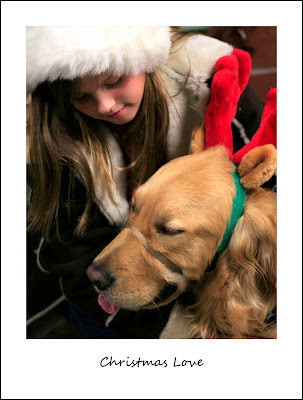

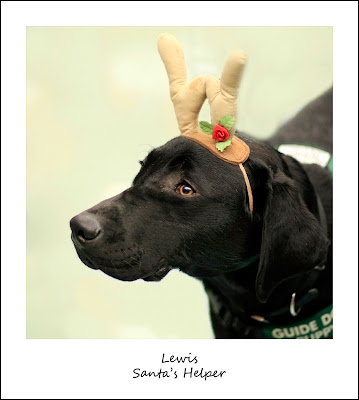

 Dogs and puppies from Guide Dogs for the Blind bring holiday cheer to children with special needs.
“Tis the season to be jolly….”
All puppy raisers for Guide Dogs for the Blind (GDB) know that nothing brings a smile to a person’s face faster than when a Guide Dog puppy enters the room. The puppies have a way of making hospital patients feel better and leave senior citizens with pleasant memories. Young children respond in amazement as the puppies in green jackets walk into a store. Whether young or old, all respond the same way – with smiles and cheer.
The puppies seem to be able to break through to people who are severely developmentally disabled . While most of the time, these are people seem locked inside, unable to communicate or respond to the world around them, something wonderous takes place in the presence of a Guide Dog puppy.
For the past 12 years during the holiday season, GDB puppy raisers in Carson City, Nevada, have taken their pups to visit a residential facility for people with severe mental retardation. We go to sing Christmas carols and to bring puppy cheer.
Even though most of us can’t carry a tune, we go each year just to watch the way our puppies respond to these special people and the way the residents respond back. You can see a slight awareness as a resident’s hand touches a puppy’s fur. A puppy kiss brings a reaction that can only be described as magical.
Some of the club’s career changed dogs, now certified as therapy dogs, also attend. Together puppy raisers and Guide Dog puppies are bringing the spirit of the holidays to a group of very special people.


Thursday, December 29, 2011
Riding that K9 Buddy Train! Part 1

Meet Natura!
This spunky yellow Lab decided not to become a Guide Dog after all -- (she didn't like air travel), so she followed her nose to a new career -- as a K9 Buddy. As luck would have it, she's going to live with a very special young boy -- and just in time!
In recent months, Zach Thibodeaux's eyesight has deteriorated rapidly, the result of a condition called cone-rod dystrophy that will leave him mostly or totally blind. The 9-year-old from Lewisville, Texas, has been preparing for life without vision by learning to walk with a cane. He and his family applied to Guide Dogs for the Blind to get a K9 Buddy dog. Zach is about to be surprised when he soon gets his wish.
In recent months, Zach Thibodeaux's eyesight has deteriorated rapidly, the result of a condition called cone-rod dystrophy that will leave him mostly or totally blind. The 9-year-old from Lewisville, Texas, has been preparing for life without vision by learning to walk with a cane. He and his family applied to Guide Dogs for the Blind to get a K9 Buddy dog. Zach is about to be surprised when he soon gets his wish.

So, with Natura ready to become a K9 Buddy, and Zach needing one, the only problem became how to get her to Zach? GDB Community Field Representative Sandi Alsworth hatched a plan to create a “puppy train” of relay drivers (volunteer puppy raisers in several states) to transport the dog by car through each leg of her journey to Zach and his family. Thinking it would be a tough task, especially during the holidays, she was surprised by the outpouring of support from our puppy raising volunteers.

This morning, December 29, Natura started her journey to Zach. She'll arrive to surprise him on Sunday, January 1. Can you keep a secret? If so, we'll continue to bring you updates along the way contributed by members of our GDB Family -- people brought together, as so often happens here, through the shared love of a dog.
What is a K9 Buddy, you may ask? Find out! Watch this video to learn more!

Friday, December 23, 2011
Raising Emmy

by Kim Harney
In the fall of 2006, my roommate and I received my first baby Guide Dog Puppy -- a wrinkly, female, yellow Lab named, Emmy. My roommate had raised Emmy's dad. We could not have been more excited to raise a puppy that we got to help name and would remind of us of her dad, Simon.
I knew raising a Guide Dog puppy was going to take up a lot of time, a lot of patience and there would be many protocols for me to learn. What I didn’t know is that it would change my life.
Emmy was an amazing puppy (I can’t say that about every puppy!) She was beautiful, sweet, cuddly, funny and the most loyal dog I had ever had. She became my best pal and slept on the floor next to me most every night (Ok, we won’t tell anyone that I occasionally woke up with a furry foot warmer.) Emmy became the center of my world and had a following everywhere she went. Throughout her training she was an excellent ambassador for GDB and learned everything we threw at her like a pro. She was simply perfect.
In May of 2007, the day came when Emmy would go back to GDB for her formal training. It was then I realized how close we'd become. The 20-minute drive to the GDB campus seemed remarkably quick compared to the drive home, which I will always remember, felt like hours. In addition to dropping Emmy off that day, I left a large piece of my heart at GDB. For the next six months, I would go to bed every night wishing my phone would ring to say that Emmy was coming home --I truly believed she belonged with me and would come home.
In October of 2007, we got word that Emmy was excelling in her training and my dream of her coming home was beginning to look less realistic. Thanksgiving of that year, I heard the words I had been praying I would never hear:“Emmy is in class to graduate.” To say I was heartbroken would be putting it mildly.
How could a dog I put so much work into be going to live with someone else? Who could possibly need Emmy more than I did? Who else would tattoo her name on their own foot?
That following week, I got the answer to all of my questions when I spoke with Emmy’s new partner, Tim. Tim is from Missouri and is legally blind due to multiple sclerosis. Tim had fallen in love with Emmy in the short few weeks they had been together, and before our short conversation was over, I knew that Tim needed Emmy and that is why she would not be coming home to me.
Despite knowing how much Tim needed her, I knew that meeting Tim would forever be one of the hardest days of my life. My heart was breaking over a dog that I had become so attached to and never believed would leave me. Actually seeing her beside Tim made me realize what our hard work was all about. My feeling of heartbreak suddenly changed into a feeling of pride.
Many of our friends and family came with me to see Emmy graduate that day. Everyone knew how special she was to me and what a hard day it would be for me. I made it through the day because of Tim. I knew he loved her as much as I did and she was going where she was meant to be.
Emmy will forever be my “heart dog” and Tim will always be a part of my family. Tim and Emmy have an unbreakable bond and nothing in my life will ever compare to raising Emmy and seeing her bond with Tim.
We have raised 12 dogs since Emmy. Each are special in their own way. One, Emmy’s half-sister, came home to stay, and I am thankful every day that she chose to stay with us.
Raising Guide Dogs isn’t just about potty training, following protocol and socializing puppies. It’s a life changing and heartbreaking job. But Emmy and Tim serve as my daily reminder that my heartache is nothing compared to the life changing relationship these dogs form with their partners.
Friday, December 9, 2011
A Precious Gift

by Kathy Hinz
When our son Travis (11) was 8 years old he wanted to do a community service project. We started looking into projects that the family could do together. We knew there was a Guide Dogs for the Blind puppy raising group in the area and contacted the leaders. Within the first month, Travis and I knew we wanted to become involved with such a wonderful group of people. We encouraged the rest of the family to join with us (Shawn, then 10, and my husband, Steve). Before we knew it we were happily raising puppies for Guide Dogs for the Blind. We each have our own ‘puppy jobs’ and it has really given the four of us a lot of extra family time together.
Last Spring we had the opportunity to meet a puppy who made a huge difference in our lives. We worked with a transfer puppy named Vicky. She was small, gentle and kind. Immediately Vicky blended into our household. She would take long naps, lie and watch the family, and always, always at the drop of a hat, be ready for action. Vicky was so well behaved on outings that our boys would proudly strut around stores working her. Once, Travis was working Vicky at Fred Meyers, and when the two of them returned, a woman was following them. She told me that she just had to find the mom who was with Travis and Vicky. She went on to tell me how impressed she was that Travis was so responsible and how incredibly impressed she was with Vicky. She spent several minutes explaining everything that Vicky and Travis had done one aisle over. It was the highlight of our day.
We worked hard to make Vicky into a potential guide dog but, unfortunately, she was fearful of riding on public transportation. Our Field Representative from GDB, Pat Cook, worked with us to increase Vicky's comfort on buses using GDB Food Protocol techniques. Many afternoons were spent riding the local bus route where Vicky became well known to regular riders. Although she improved, she never became comfortable with the noise and movement of the vehicle.
Toward the end of Vicky’s stay with our family, Pat asked us if Vicky would make a good K9 Buddy – we slowly, quietly said “Yes.” You see, the whole family had bonded with Vicky so heavily, that we couldn’t imagine her living with anyone else. However, we wanted her to have a positive influence in a sight impaired child’s life.
The time came for Vicky to be placed as a K9 Buddy, and as proud as we were of Vicky, we were sad that she would be moving on. When the time came for Vicky to leave, we repeatedly told Pat that Vicky was always welcome to return to our home. We wanted her new family to adore her and for the placement to be successful. We sent her new family pictures of Vicky and a long letter all about her. We put our e-mail address all over everything we could find so that if the new family wanted, they could contact us.
One evening, a new name popped up on our e-mail. Jennifer, Vicky’s new mom, had written. Our family was just sitting down for dinner and we all stopped eating and became riveted as I read the e-mail out loud. It was clear within the first two sentences that Vicky had joined a loving, caring family. Vicky went to live with an 8 year old named Luc. Since losing his vision the year before, Luc had night terrors on a regular basis. The day Vicky entered their family, the night terrors stopped. Vicky had provided just what Luc needed. Our favorite picture is of Luc and Vicky in a warm embrace. Both look happy and at ease with one another. Vicky’s new life includes hiking, caving, swimming, playing with Luc and his little brother Gabe and lots of cuddle time!
I was crying so much reading Jennifer’s letter that I needed to take several breaks. As I finished the letter, both Shawn and Travis looked me and said, “We did the right thing.” Even though it was difficult to say good-bye to Vicky, the joy that entered our hearts when we read the e-mail and saw the pictures made the whole experience a highpoint of our year.
Monday, November 28, 2011
A Homecoming Week to Remember
 by Olivia Mesches, GDB puppy raiser
I am a Junior at Modesto High School in California. Our student body has a long history of displaying extreme spirit and pride during Homecoming Week.
My 10-month-old Guide Dog Puppy in Training, Gaston, was no exception. Gaston dressed up for every spirit day (or, rather, I dressed him up...often to his embarrassment) including Western Day, Neon Day, Explorer Day, Pirate Day, and of course, Spirit Day!
He wore each costume proudly. Occasionally, though, he'd heave a heavy sigh, his sad puppy eyes staring deeply into people's souls as if to say "Look what this crazy lady did to me! Please take this costume off me and have her committed!" Needless to say, Gaston attracted more "ooos" and "awwws" during Homecoming Week than at any other time!
 Luckily, Gaston goes to school with me every day and has grown accustomed to such fame, so he has learned not to let it go to his head. However I am quite sure that, had there been a place for dogs on the Homecoming Royalty ballot, Gaston definitely would have won.
I convinced myself that dressing my dog up was really benefitting him in addition to being fun for me and everyone else who encountered him. (I know one dog who won't be having any sensitivity issues once it comes time for him to put on the big boy harness.)
There were a few costumes, however, that made my male friends cringe...such as the hot pink sweater he wore for Neon Day or the red tutu he wore on Spirit Day. But I assured them that Gaston is very secure in his masculinity (after all, there is an entire song dedicated to this fact in Beauty and the Beast). If you were to ask him, I definitely think Gaston preferred being a cowboy or a pirate.
 Gaston and I finished off this fun and crazy week at a rally. He had the privilege of sitting in the front row seat and had plenty of eyes on him. Unfortunately, he slept through most of the activities including the school band's performance (even though they were set up right behind us). The resounding din of a gym full of hyped-up high school students right before school let out for the weekend wasn't enough to rouse him. He did get up lazily to help escort me across the gym, providing for the majority of the cheering and cuteness factor.
Gaston was such a good sport and he really made Fall Homecoming special and memorable for a lot of people, myself included.

Olivia and Gaston
Monday, November 7, 2011
Keeping Up with Caleb

Follow Caleb on his latest adventures as he takes to the air (by plane, of course) for a wonderful vacation in San Francisco. And then, he whined (not really) and dined at the Canine Heroes Wine Auction in Napa Valley -- a fundraiser that supports veterinary care for GDB dogs and pups.
Raiser Megan says, "Caleb is with us—and more specifically, me—all the time; I am his person. He will go anywhere and do anything for me. Over the last year, we’ve built an amazing bond and trust that we’ll always have no matter what his future holds. He may go weeks, months or years without seeing me but his reaction will be the same and the reunions will be joyful no matter how long we’ve been apart.
"I honestly don’t think any of my pups spend their days pining for me. All of them are with their soul mates and where they are meant to be. I am the awesome aunt who brings special presents and treats. From day one, I remind myself eventually we’ll have to say goodbye but as recent as last night I find myself tearing up at the prospect. It never gets easier, in fact, sometimes I think it gets harder with each dog."
Thank you Megan, and all of our puppy raisers, from everyone at GDB!
Subscribe to:
Posts (Atom)