Showing posts with label retired guide. Show all posts

Monday, May 21, 2012

Will Guide Dog Galleon Win the Hero Dog Awards?

Golden Galleon and black Lab Brinkley by the side of Larry Marcum

My retired Guide Dog Galleon, from Guide Dogs for the Blind is my hero dog because he literally changed my life in countless ways. He guided me for over nine years as my eyesight diminished.

He guided me to stand at the Lincoln Memorial, which had always been a lifelong dream of mine. He guided me to go places, meet people and do things that I would never have attempted without him by my side. He made it possible for me to fly over 20,000 miles on trips.

He guided me through three funerals of close family members, and through my wedding. He has taught me love, compassion, patience, understanding.

He has taught me that a Guide Dog does more than guide, a Guide Dog helps a person to live their dreams! --Lion Larry Marcum and the guys (pictured: retired Galleon and my new Guide Brinkley) of Forest Ranch, California

Will retired Guide Dog Galleon win the Hero Dog Awards? Only if you vote! Vote every day and be sure to share!

Saturday, April 7, 2012

Guide Dogs for the Blind Wishes You a Happy Easter!

three yellow Labs wearing bunny ears with colorful Easter eggs between their paws

Dakota, Desmond and Culver say, "You can see on our faces we're egg-cited to wish you a tail waggin' Happy Easter!" Want more cuteness in your life? Become a Facebook fan of Guide Dogs for the Blind (www.facebook.com/guidedogsfortheblindfans)

Monday, November 14, 2011

Saying "Goodbye" to Denver

German Shepherd wearing red scarf

by Bonnie Finsthwait, co-leader, Auburn Foothills Guiding Eyes

In 1998, I received a fluffy, 8-week-old German Shepherd puppy to raised named Denver. I had been raising Guide Dog puppies since 1985, and knew from the minute I held Denver in my arms that he would go onto a great career as a working guide. Denver was energetic, smart, and quick. He loved to work and found such joy in being with people. It was a pleasure to handle him and as I watched him step forward into life as a working guide in September, 2000, I was very proud.

His first blind partner loved him immediately and they did very well together. They lived in a small rural town in Nevada with no sidewalks, and little traffic. Unfortunately, this gentleman died suddenly in May of 2001 and Denver was returned to GDB.

After a month's retraining, Denver was placed with another gentleman, to graduate in July, 2001. Denver continued this career for the next eight years in the Sacramento Area with lots of traffic, living in an apartment building and heading off to an office each day. He adjusted well to this new environment as I knew he would.

In late 2009, I received a called that Denver was being retired, and was given the opportunity to adopt him as my pet! What a joy it was to see him again and know that we had come "full circle" together! And, after not seeing each other for eight years, he remembered me and was as overjoyed to see me as I was him!

Denver spent the next year and a half on our ranch in the Sierra Foothills "at pasture" enjoying the freedom of our land and "educating" the new Guide Dog puppies I have continued to raise. In July of this year, Denver died of natural causes in my arms. His big heart just stopped...

I have always felt so fortunate and privileged to raise these wonderful dogs, and Denver gave me the gift of his love in his puppyhood and then in his elder years. He worked hard, played hard and loved much...he was a sweet soul who gave his all to his people. Goodbye Denver.

Friday, October 21, 2011

Finding Homes for Retired Guide Dogs

four black Labs with greying muzzles

by Steve Grunow, GDB Dog Placement Coordinator

Just as we humans retire at different ages and often have second careers, Guide Dogs are retired at a variety of ages, and they often take on significant new roles in their adoptive homes and new families.

Following are the stories of some retired guides that the Guide Dogs for the Blind (GDB) Dog Placement Program has matched up with carefully chosen adopters during the past year. The names of the dogs have been changed here to protect the privacy of their people --- though the dogs themselves probably don’t care a lot about privacy as long as good food, interesting toys, regular walks, and lots of attention and petting are being provided!

1. Carmela, a female black Labrador Retriever, was retired at 4 years of age because her vision-impaired GDB graduate was experiencing health issues that prevented her from continuing to use Carmela as a Guide Dog. After an evaluation at GDB, Carmela was matched with a local middle-aged woman and her adult daughter. Carmela now benefits from the dog- savvy which the daughter had learned previously by being a volunteer with a local dog rescue organization in San Francisco. Because Carmela loves other dogs (not all dogs do) this family was chosen for her, also, partly because the family already had a resident 10-year-old pet male Labrador retriever. One of Carmela’s new “jobs” is to play with the family’s senior Lab to help keep him feeling and acting younger.

2. Flora, a female yellow Labrador Retriever, was retired at 6 years of age when her GDB graduate passed away. An older local woman who has special needs was selected to be Flora’s new mistress due to the adopter’s long term commitment to GDB, her past experience of having successfully owned a previous “career change” dog from GDB until that dog’s natural death and because she planned to take Flora on visits to a nearby medical facility to bring smiles to the faces of patients there.

3. Amity is a female yellow Labrador Retriever who was retired at 2 years of age because Amity seemed unduly stressed by being out in the big world doing guidework. Amity had been raised with children and she is unusually calm and well behaved for her young age. So, Amity was paired with a family that includes two small children, a dad and a mom, in Los Angeles. The dad is a volunteer at a Southern California organization for blind people. Per an email from the adopters, “Amity is doing great and she is adapting very well to her new home and family. She is great with the kids (and with adults, too) and we are all very much enjoying her. … Thank you for matching her up with our family. We couldn’t be happier.”

4. Holly, a female yellow Labrador Retriever, was retired at 3 years old after about a year of guidework. Per Holly’s GDB retirement paperwork: “Holly… while capable of working at an exceptionally high level, has a persistent interest in other dogs that is high enough to end Holly’s career as a guide…” Ironically, Holly had also been described as “a little intolerant with other dogs” when she was running with a group of other dogs in community run at GDB (ironic, since she was so interested in other dogs while she was working and was supposed to be ignoring them). During her stint as a Guide Dog, Holly had also developed expert skills in “counter surfing” (snagging forbidden food off counters). Again, per Holly’s retirement paperwork, “Preventive measures (keeping the counters clear) have improved the situation somewhat, but in new situations Holly will still look for the opportunity.” Because of Holly’s tendency to steal food, and her discomfort with some other dogs, Holly was placed with a middle aged woman who currently had no other dogs in her home in California’s Central Valley, but she had previously happily coped with a less-than-angelic GDB “career change” dog which she had cared for until that dog’s natural demise. So she had already learned coping skills and tolerance for living with a less-than-perfect canine. The adopter’s adult son and his two children live nearby and they spend a lot of time with Holly and her new caretaker. Per an email from Holly’s new person, “Even though I haven’t had her long, I already love Holly and I am so glad to have her with me. She is very sweet and loving and quickly became popular with the whole family… Thank you so much for placing her with me.” (No mention of whether Holly has yet had an opportunity to display her counter surfing talents to her new folks...)

5. Huntly, a male black Labrador Retriever, was retired as a 2 year old after a brief guidework career due to his being too highly distractible and too active for optimal guidework. Because Huntly had been raised with a child, and has a high energy level, he put into an active family in Santa Barbara, California, where his current “duties” involve “doing a lot of hiking and cuddling with the kids” per the adopters.

6. Mikette, a female yellow Labrador Retriever, guided a GDB graduate briefly, then was retired as a 2 year old because, though she was well trained, her high energy level proved to be incompatible with optimal guidework. (While Mikette was at GDB awaiting adoptive placement, a GDB employee quipped that while she was fully trained as a working Guide Dog, “Mikette didn’t seem to be able to completely envision herself being in that role!”) Coincidentally, around the time of Mikette’s retirement, a middle-aged blind lady who lives alone in Southern California was sadly anticipating that her own elderly long-term companion, a (non-GDB) female black Lab, was not going to be around much longer, and the lady applied for a companion (not a working guide) from GDB. Since Mikette had actually been a Guide Dog, albeit only for a short time, her training and experience made her a good candidate to be a canine friend for this vision-impaired woman. A brief month after this applicant had adopted Mikette in April, she emailed to GDB: “I could not have received Mikette at a better time, as on May 31 I had to have my old dog put to sleep.”

Our thanks to the many people who help our retired Guide Dog heroes enjoy their remaining years.


Do you have stories to tell about your older dog? You can show your love for your dog and support for GDB by making a tribute or memorial gift in his or her name.

Friday, October 14, 2011

Human “Angels” Who Adopt Senior Retired Dogs

yellow Lab next to dog adopter

by Steve Grunow, GDB Dog Placement Coordinator

Guide Dogs for the Blind (GDB) really appreciates ALL of the people who adopt the “career change” dogs and retired Guide Dogs. There is a special place in the hearts of all the staff in the Dog Placement Program for those individuals and families who choose to provide homes for the elderly retired guides.

GDB’s dogs tend to live about 10 to 14 years. Senior dogs often have age-related veterinary issues and need to be given medications. Some canine oldsters have trouble climbing stairs. They usually physically cannot jog, hike, go bicycling or play games of fetch with their people --- abilities which many potential adopters require in the dogs that they want to adopt. Some geriatric dogs are not the specimens of doggy attractiveness that they were in their youths. Probably most significantly, adopting a dog “of a certain age” means knowing and accepting that the pooch has only a limited portion of its lifespan left, despite the bond that will be developed, and that there is bound to be some grief in the end.

Fortunately for GDB and its lucky elder former guides, there are some brave and “saintly” adopters who are content to see the dog-adoption glass as being half FULL with their furry "AARP members". The dogs are usually much calmer, easier to control, don’t require as much exercise and are better behaved than most young dogs.

Following are some stories of older retired Guide Dogs the GDB Dog Placement Program has matched with very accommodating and cherished adopters over the past year. The dogs’ names have been changed here to ensure privacy for the people involved.

1. Allure, a female German Shepherd, one of the last few of GDB’s guides of that breed, was retired at 10 years old due to having a mast cell tumor (which had been successfully removed, but could recur). Allure also had a torn cruciate ligament, which was not causing serious problems, but was incompatible with Allure’s continuing to work as a guide. After some veterinary care at GDB, including extensive physical therapy, it seemed best for all involved that Allure would go to Arizona to grace the home of a middle-aged couple, whose past experience with raising German Shepherd puppies for GDB had given them important insights into caring optimally for this sometimes- sensitive breed. Allure now attends the meetings of the current GDB puppy raisers and their pups in her county, and she demonstrates good behavior for those young "whippersnappers" there that are currently being educated as future working dogs for Guide Dogs for the Blind.

2. Ginny, a female Golden Retriever, was retired at 10 years old due to normal age-related slowing of her pace. She also has some eye abnormalities that need to be monitored, so she was lucky to be adopted by --- a veterinary ophthalmologist (eye doctor)! The adopter wrote,”… as long as Ginny doesn’t mind my cats and other dogs, she can have a forever home with me.” Great for Ginny herself, and great for Ginny’s eyes!

3. Orion, a male yellow Labrador/Golden crossbred, was retired at 10 years of age when his GDB graduate passed away. Orion’s adoptive family in California’s Central Valley consists of a middle-aged mom and dad, two adult daughters (one of whom has a serious medical condition and Orion can be a comfort to her), two very old other dogs, horses, and a cat. The adopters had gained a lot of dog savvy by raising a puppy for GDB a number of years ago. Their prior dog knowledge is a help in caring for Orion. They have reported that Orion is doing well, and that they are really enjoying providing Orion with a “ vacation retirement home” to reward him for his prior eight- years of service as a working Guide Dog.

black Lab with pink tongue

4. Lindy, a female black Labrador Retriever was retired at 10 years old and with a tumor in her leg. After successful surgery through GDB, Lindy was offered to an elderly woman with limited mobility who has generously previously taken in a number of previous GDB dogs, both young and old, with special needs. She and her family have lots of knowledge about dogs and experience with dealing with lots of canine medical and behavioral issues. Lindy is doing fine, has received radiation therapy to hopefully prevent the regrowth of her tumor ---and she is coping gracefully with having gone from being a “princess” of a former only- dog in her former GDB graduate’s home to sharing her new human “mom” with a pack of several other dogs in this home.

5. Carrot, a female yellow Labrador, has had a unique and multi-faceted life! She was retired from guidework as a 4-year-old because her GDB graduate’s wife had passed away and the man was no longer using a Carrot as a guide. Carrot then was still quite young for a retiree. So after an evaluation at GDB, Carrot entered training with a hearing dog program (hearing dogs are trained --- with food treats --- to alert their deaf human partners to sound). Carrot aced hearing dog training (most Labradors are overjoyed with any activity involving food treats). She then had a successful eight-year career as a hearing dog with a woman in Colorado. By Colorado law, a hearing dog can go just about everywhere with its human, just as a working guide dog can. Then Carrot’s hearing dog partner very sadly had to return Carrot to GDB because the woman’s deteriorating health prevented her from continuing to care for the dog. Carrot has now become the constant companion of an older man and woman who were selected for Carrot because they had previously successfully owned two other older retired Guide Dogs until those dogs’ natural deaths --- and they had then signed up again to take in yet another oldster. The new family has acreage in both California and Texas. Per a GDB employee who knows the adopters, “They are all getting along famously. Carrot follows them everywhere and they adore her. They are inseparable!” So Carrot’s life experiences have ranged from Guide Dog to hearing dog to ranch dog and remarkably tuned-in companion --- quite a canine resume!

6. Dane, a male yellow Labrador/Golden crossbred, was retired at 11 years old due to normal geriatric conditions. While he was at GDB awaiting placement, he was often referred to as “the old gentleman”. He was offered to a middle-aged couple who have purposely chosen to repeatedly take on older retired guides as their way to actively help support the work of Guide Dogs for the Blind. There is another former Guide Dog currently in their home, and these adopters have also previously taken in several other senior retired guides and cared for them until those dogs’ natural deaths.

There are not many adopters who will take on an aging dog that may be relatively close to its demise, happily care for, and love that dog until it passes on --- then do that again, and again, and again! For a few hardy and unusual souls, often senior citizens themselves, welcoming these animals into their homes seems to be more about what they can offer the dogs than about what the dogs can do for the people --- and these “human angels” seem to be OK with that. GDB really thanks those people who thrive on provide comfy retirement homes for GDB’s "geezers" and "geezerettes".

Understandably, there is usually some grief at the end --- but these “angels” have not complained or expressed any regrets.


Do you have stories to tell about your favorite "geezer" or "geezerette"? What life lessons have they taught you?

You can show your love for your dog and support for GDB by making a tribute or memorial gift in his or her name.

Saturday, September 17, 2011

The Path With a Guide Dog

Larry in rocking chair with his arm around yellow Lab Galleon

by Larry Marcum


Two months ago I retired my first Guide Dog Galleon after more than nine incredible years of him guiding me. Since retiring him I have had to go back to using the white cane, which I rarely used since receiving Galleon in January of 2002. Going back to the cane has been frustrating to say the least, but more than anything I have realized that I again feel like a blind man. That may sound strange, but I had not totally realized over the nine years with Galleon that he took so much stress out of my travels, how much he was truly guiding me, how there must have been so many obstacles that he effortlessly took me around that I did not know were there, that I now find with my cane. Now the tired shoulder muscles, headaches, and hunched back have returned. I now realize that while Galleon guided me I was able to walk standing straight up with confidence and being able to forget, at least during the time that we were walking, about my blindness and really allow my other senses to take in and enjoy our surroundings.


Galleon became such a part of me that I now realize how much we became one - a team. Although I always had my left hand holding a harness handle, it became so natural that I did not feel blind while out in public. Over the years we became so attuned to each other, it got to where I rarely needed to give him commands, he just seemed to know where I wanted to go.


Galleon and I flew over 20,000 miles together. On one trip we flew to Washington D.C., where Galleon guided me to stand at the Lincoln Memorial, which was a lifelong dream of mine. Galleon guided me up the steps of our nation’s Capitol, and to stand at the wrought iron fence surrounding the White House. As Galleon guided me to the Vietnam Memorial Wall, because of my small tunnel of vision, all that I first saw was a wall just a few inches tall. But as he guided further along, the wall was soon looming way over my head, with so many names on it that boggles the mind. Galleon guided me around the World War II Memorial where I was privileged to see our veterans reminisce together about that war. With my limited vision I got to see the never-ending hills of Arlington Cemetery that hold our freedom fighters of past wars.


We traveled together on planes, trains, buses, taxis, and boats. We walked on beaches, trails, cities and parks. He was at my wedding, several funerals, parties, church and meetings. We won awards together, played in the snow, walked in the rain, and sweated in the heat. He has come and sat at my side when I cried, and danced with me in joyous times. For more than 3,000 nights he has been at my bedside all night, every night, never once getting up and wandering until my feet hit the floor in the morning.


My greatest realization about guide dogs is that a guide dog does more than guide; a guide dog helps a person to live their dreams. Thank you, my Galleon for helping me to live so many of my dreams!


Galleon continues to live with my wife Ida and I, enjoying retirement here at our mountain home, and oh, how he will enjoy the company of my new guide in October! You see, because of so many caring, giving and dedicated people associated with Guide Dogs for the Blind, I am blessed to get to return there September 25th to begin the path with my next Guide Dog.


September is National Guide Dog Month! Help make new friends for GDB by sharing this post with your soul mate.


Wednesday, July 7, 2010

Retired Guide Enjoys Career #2

By Caitlin Ewing

Retired Guide Alomar
In 2001, I raised Alomar for Guide Dogs. From the day we brought him home, we knew he was destined to be a great Guide Dog. He had a sweet, mellow disposition and an aptitude for work. After an early retirement at the age of 5, Alomar came back to our home and began his second career as a therapy dog. Twice a month, Alomar spends the afternoon at Stanford Hospital sitting with patients on their beds and getting all the belly rubs he can ask for.

I recently sat with a patient before they were going in for major surgery. Alomar sat on the bed with his forehead pressed against the patient's forehead getting his ears rubbed. It was such a simple gesture that created a beautiful moment. When it was time for the patient to to be taken to the operating room, I was told that the patient likely wouldn't have stayed so calm if it wasn't for Alomar's gentle presence.

Not only has Alomar had two very successful careers but he has touched the lives of many people. We look forward to sharing his gifts for many more years to come.

Alomar was featured on the local news for his work as a Therapy Dog at Stanford Hospital; check out the segment http://bit.ly/CC_alomar (scroll down to the second video on the page).

Monday, March 8, 2010

Retired Guide Gets a Disney Salute

Kathy Kennedy and Katela
GDB alumna Kathy Kennedy works as a reservation sales agent at the Walt Disney Travel Company. The following is an article printed in the Disney employee magazine about the office retirement party thrown for Kathy's guide, yellow Lab Katela.

In August of 2001 a new friendship developed between Disney Travel Reservation Sales Agent Kathy Kennedy and her Guide Dog, Katela. At the time, the playful Labrador pup was just 2 years old and ready to assist Kathy, who is legally blind.

“She guides me around trees and posts and if something is in the way, she takes me around it,” she said.

Like many owners of assistance dogs, the trained companion allowed Kathy to feel safe and lead a confident, independent life. When she is with Katela, she says people are more receptive to her than if she walks with the assistance of a cane.

Although the dogs appear approachable, Kathy stresses the importance for others to be aware when Guide Dogs are with their owners. “When we are holding on to their harness they are working and their focus should be on us,” she said. The appropriate way to approach someone with a guide dog is to first ask the person’s permission to pet their companion. Avoid calling out the animal’s name as it may distract them from doing their job.

After eight years of service, Katela is being retired and will be adopted by Kathy's sister who has three young boys to play with their new family member. Kathy will be getting a new guide in a few short months. “She is 70 years old in dog years so it must be hard for her,” said Kathy. “It is breaking my heart to retire her, but I will still get to see her.”

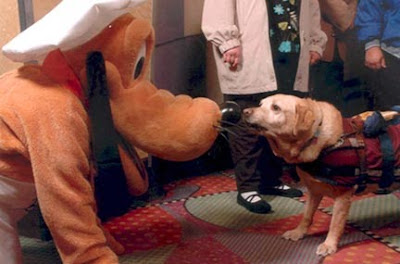
A retirement party for Katela was held at The Walt Disney Travel Company, complete with treats and smooches from Pluto!

Katela gets a smooch from Pluto

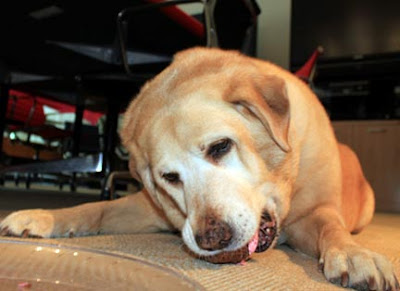
Katela enjoys a well-earned retirement treat

Monday, December 21, 2009

Food Rewards Are Fun!

This is a fun little anecdote submitted to us by GDB alumna Tiffany Jolliff:

Tiffany with Santana and Railey
My first guide dog, Santana, has been retired since November of 2008. I now have a successor guide named Railey (all three are pictured). However, this story concerns Santana.

I had gone to bed and taken Railey with me. I was almost asleep when I heard my cell phone ring. I answered it, and my dad asked me if I had fed Santana earlier that evening. Confused, I replied that I had and thought nothing more of it. The next day, Dad told me the story behind the phone call.

Santana was in the living room trying to communicate with my parents. She kept looking into the kitchen and back at my parents. She was jumping up and down, wagging her tail, and generally getting more and more excited. My dad said she even resorted to howling at the top of her lungs several times.

Finally, Dad decided to follow Santana into the kitchen. She tore into the kitchen and sat purposefully in front of the refrigerator. (On top of the fridge is a giant box of dog treats.) As Dad watched, Santana began doing her obedience routine all by herself. She sat, laid down, sat back up, and laid back down. Then, she sat and stared daggers at the treats until Dad got one for her. I'd say that those food rewards really do work, even with retired guides!

Aww! And we think Santana has earned treat or two in her retirement! Thanks for sharing Tiffany!

Tuesday, December 1, 2009

Retired Guide Still Making a Difference

We recently heard from GDB alumna Deborah Armstrong of Milpitas, Calif., about the great work that her retired guide, Boston, is doing as a therapy dog. She writes:

Boston, my retired guide, is now the pride and joy of Bob, my wonderful sighted husband. Boston and Bob are both certified by Therapy Dogs International.

I like to show GDB staff that even when a dog retires, it is still loved and can make people happy. My third dog, Glade, the one before Boston, also did therapy work, and lived to be almost 17 years old!

I am happily working Bev, my fifth guide. I work full-time at 112-acre Deanza community college in Cupertino. I am responsible for helping disabled students solve their technology problems all over campus, which means I have to run between many buildings like a competent tech who knows how to fix your computer! Zipping around with a confident Guide Dog sure doesn't hurt the image!

I've now had Guide Dogs for 28 years, and I have never stopped being grateful. There is no way I could do my job, my volunteer work, or function as an effective homemaker without the furry express!

The daughter of a patient posted a video on YouTube of Boston's recent visit with her ailing mother. I think it is particularly important for your hard-working instructors to see this video. None of my dogs ever stopped being useful when they retired, and I pledge that this will always be so.

To see the video of Boston at work as a therapy dog, please visit: